
AMH and Ovarian Reserve: What Your Result Really Means for Fertility and IVF
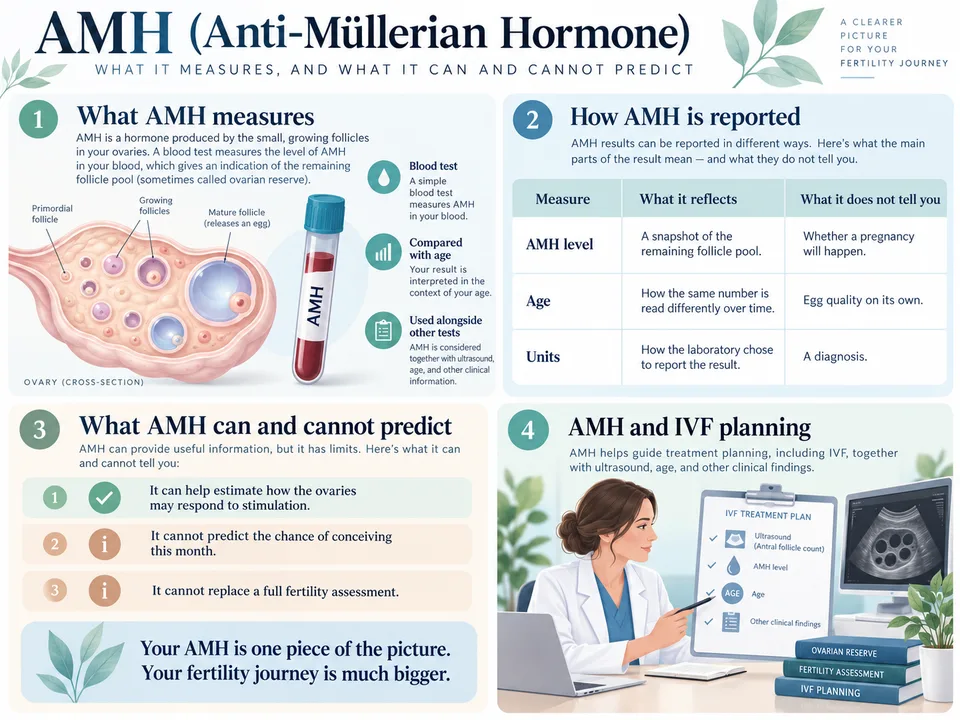
Anti-Müllerian hormone (AMH) is one of the most commonly ordered fertility tests — and one of the most misunderstood. [PLACEHOLDER — replace via Journal admin]
What AMH measures
[PLACEHOLDER] This section will explain what anti-Müllerian hormone reflects about the ovaries.
- [PLACEHOLDER] How the blood test is taken
- [PLACEHOLDER] Why the number is compared with age
- [PLACEHOLDER] How clinics use it alongside other tests
How AMH is reported
[PLACEHOLDER] This section will show how laboratories present an AMH result.
| Measure | What it reflects | What it does not tell you |
|---|---|---|
| [PLACEHOLDER] AMH level | [PLACEHOLDER] A snapshot of the remaining follicle pool | [PLACEHOLDER] Whether a pregnancy will happen |
| [PLACEHOLDER] Age | [PLACEHOLDER] How the same number is read differently over time | [PLACEHOLDER] Egg quality on its own |
| [PLACEHOLDER] Units | [PLACEHOLDER] How the laboratory chose to report the result | [PLACEHOLDER] A diagnosis |
What AMH can and cannot predict
[PLACEHOLDER] This section will separate what the result can support from what it cannot promise.
- [PLACEHOLDER] It can help estimate how the ovaries may respond to stimulation.
- [PLACEHOLDER] It cannot predict the chance of conceiving this month.
- [PLACEHOLDER] It cannot replace a full fertility assessment.
AMH and IVF planning
[PLACEHOLDER] This section will describe how a result is used when planning treatment, including IVF at GINKGO and guidance published by ESHRE.
Not sure what your AMH result means for your next step?
GINKGO can help you understand your reproductive situation, review available options and navigate the next stage of your fertility journey.
References
- Practice Committee of the American Society for Reproductive Medicine. Testing and interpreting measures of ovarian reserve: a committee opinion. Fertility and Sterility, 2020.
- Steiner AZ, Pritchard D, Stanczyk FZ, et al.. Association between biomarkers of ovarian reserve and infertility among older women of reproductive age. JAMA, 2017.
This article is provided for general educational purposes and does not replace individual medical advice, diagnosis or treatment. Medical decisions should be made in consultation with an appropriately qualified healthcare professional. Treatment availability, indications, evidence, regulatory requirements and clinical practice may differ between countries.